
AI Governance: Who Makes Decisions When Companies Use AI?
AI is no longer just automating processes — it is influencing decisions, customer interactions, and risk structures. In 2025, the real challenge for companies is not adopting AI, but governing how it makes decisions and who is responsible for them. AI-governance has become one of the most important components of modern business strategy.
According to McKinsey’s State of AI 2025, companies with a structured governance model achieve higher ROI, fewer operational incidents, and significantly reduced bias-related risks. Without governance, AI becomes unpredictable: wrong recommendations, compliance issues, legal exposure, and massive trust loss.
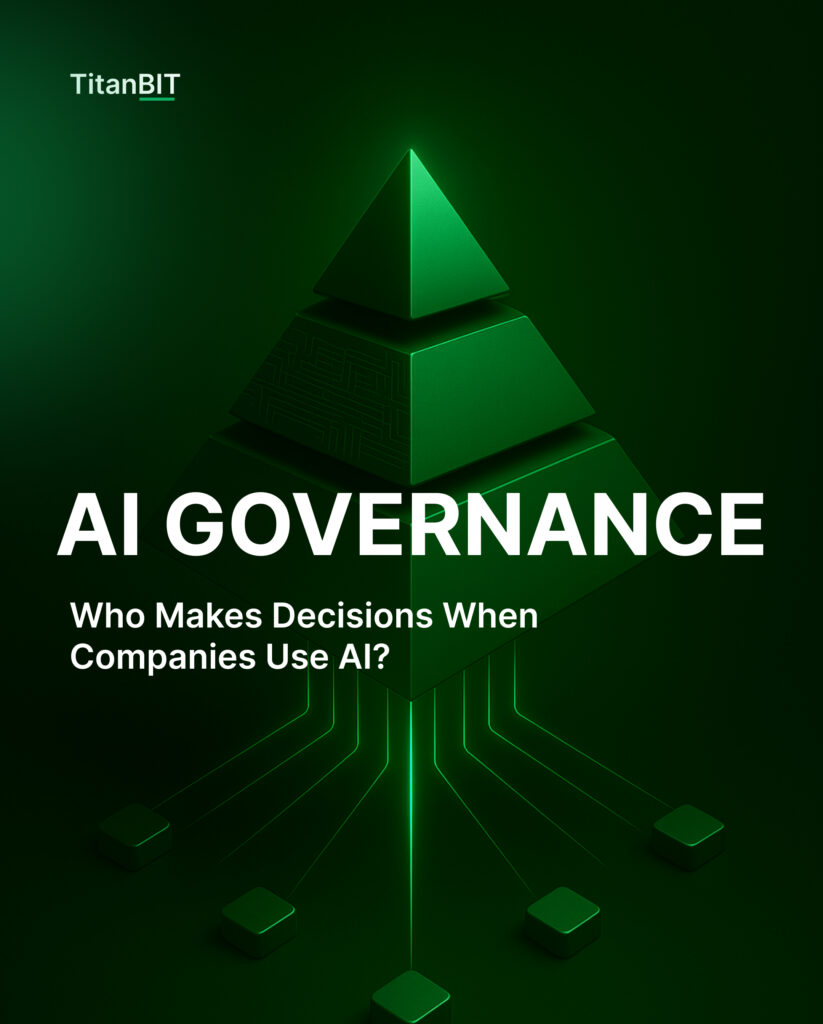
Today’s governance model is built as a controlled, layered structure:
🧩 1. CEO oversight
This is the highest-impact layer.
CEOs define principles, risk tolerance, strategic direction, and accountability. High ROI comes from leadership-level involvement because strategy cannot be delegated to algorithms.
🛡️ 2. AI compliance specialists
A newly essential role.
Compliance teams ensure operational safety, data protection, model monitoring, cybersecurity, and regulatory alignment. Without them, AI becomes a “black box” with unpredictable behavior.
⚖️ 3. AI ethics specialists
Ethics defines trust.
These teams monitor bias, fairness, transparency, and human impact. In a world where AI decisions scale instantly, ethical oversight becomes a competitive advantage — not a nice-to-have.
🤖 Why governance = competitive strength
AI can either amplify a company’s strengths or multiply its weaknesses.
Proper governance ensures AI is predictable, controllable, and aligned with business goals.
Conclusion:
AI does not replace leadership.
AI reveals its quality.