
AI Agents Are Replacing Workflows — Not People
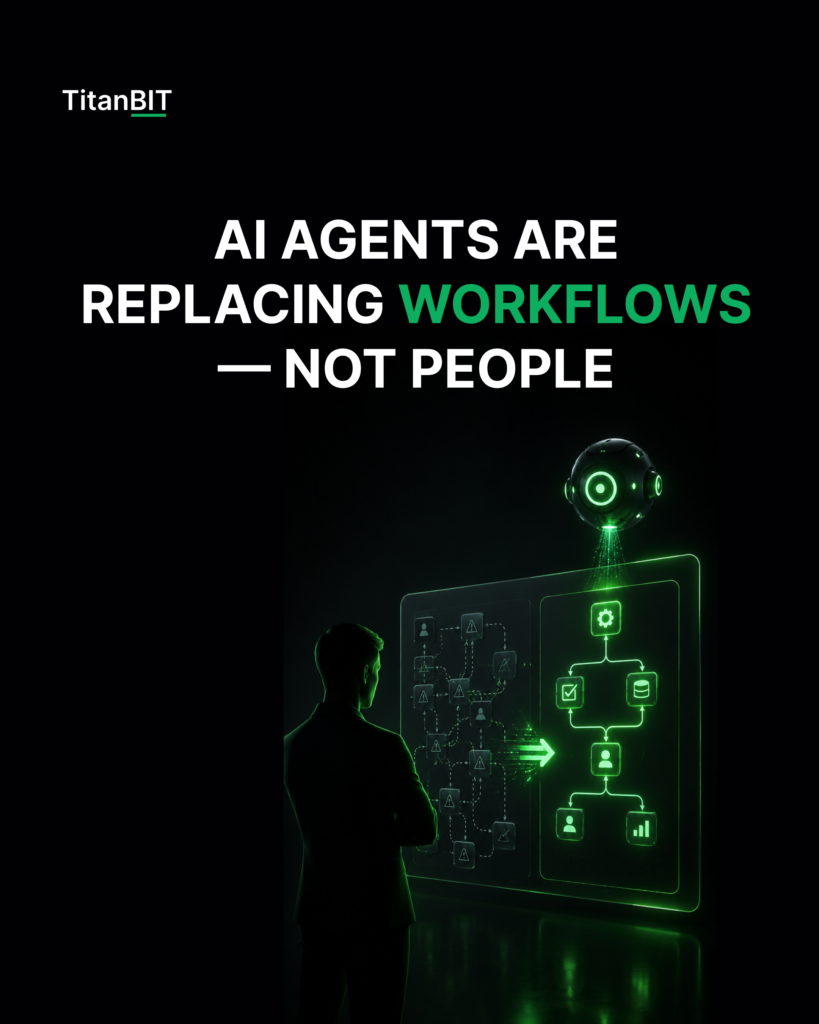
Artificial intelligence is often discussed in the context of job replacement. Many assume that as AI becomes more advanced, it will gradually reduce the need for human involvement across different industries.
But this framing misses the deeper shift.
AI is not replacing people.
It is replacing workflows.
From Manual Execution to Autonomous Systems
For years, business processes depended on manual coordination. Teams had to manage tools, transfer data, execute steps, and ensure that each part of the workflow was completed correctly. This made execution slow, fragmented, and dependent on human effort.
With the rise of AI agents, this model is changing.
Workflows can now run autonomously. Systems trigger actions, move data, and execute decisions without constant human input. What used to require ongoing effort can now operate continuously in the background ⚙️
Why This Changes the Role of Teams
As workflows become automated, the role of people evolves.
The value is no longer in completing tasks manually. Instead, it shifts toward designing how the system operates. Teams are responsible for structuring processes, connecting tools, and defining the logic that drives execution.
This is a fundamental transition.
From doing work → to designing systems that do the work.
Systems Create the Real Advantage
Many companies assume that adopting AI tools is enough to improve performance. In reality, tools alone do not create results.
Without a structured system, AI agents operate in isolation, leading to inconsistency and inefficiency. When integrated into a well-designed system, they amplify speed, accuracy, and scalability.
That’s why two companies can use the same tools and achieve completely different outcomes.
The difference is not in the technology.
It is in the system behind it.
Conclusion
AI is not eliminating the need for people — it is redefining their role.
The companies that succeed are not those that automate the most tasks, but those that design the most effective systems.
Because in this new reality, workflows are automated — but systems are still built by people.
💬 Are you adapting to this shift — or still operating inside outdated workflows?