
Your Next Customer May Skip Your Website
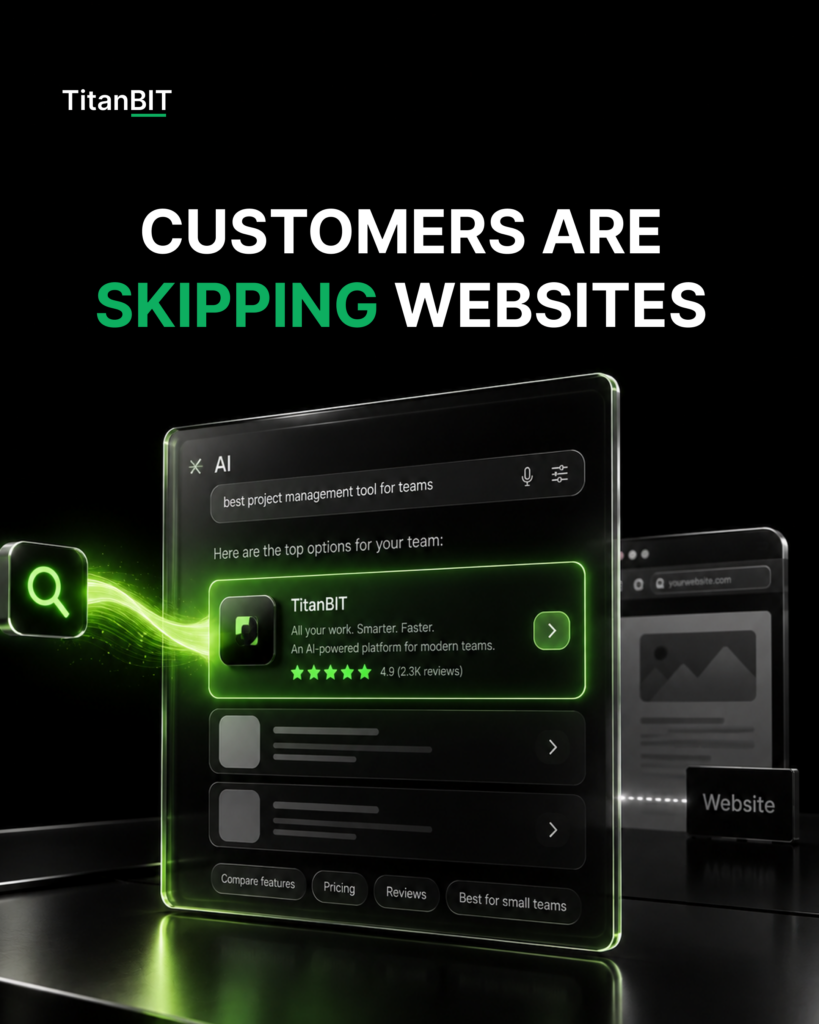
What happens when a customer can discover your brand, understand your product and compare it with competitors without ever opening your website?
This is no longer a hypothetical question for marketers.
AI-powered search is changing how people move from a question to a decision. Google is integrating advertising into AI Mode, while AI search experiences increasingly allow users to explore complex questions, compare alternatives and understand products without following the traditional sequence of opening several search results.
For businesses, that creates a significant change in the customer journey. The website remains important, but it may no longer be the first place where meaningful discovery happens.
AI Is Creating a New Layer in the Customer Journey
Traditional search was largely built around navigation.
A user entered a query, received a list of results and decided which links were worth opening. From there, individual websites did much of the work: explaining the product, communicating the value proposition and convincing the customer to continue.
AI changes this relationship because it can interpret information before the user reaches those websites.
A potential customer can describe a specific need, ask for several alternatives, compare their differences and continue asking follow-up questions without restarting the search process.
Instead of simply directing users toward information, AI can organize that information for them.
That means part of the consideration stage can now happen inside the search experience itself.
Visibility Is No Longer Only About Winning the Click
This creates a new challenge for digital marketing.
SEO, paid search and website optimization remain important. Businesses still need traffic, and customers still need reliable places to research companies, validate their choices and complete transactions.
But traffic is no longer the only way a brand can gain value from search visibility.
If an AI system mentions a company while answering a customer’s question, that interaction may influence the decision even if no website visit happens immediately.
The important question therefore begins to shift from “Can customers find our website?” to “Can AI understand when our brand is relevant?”
That distinction matters.
AI systems need enough clear information to understand what a company does, which products it offers, what differentiates those products and which customer needs they address. Confusing positioning, fragmented product information or inconsistent descriptions can therefore become more than a communication problem.
They can become a discoverability problem.
Your Website Still Has an Important Job
This shift doesn’t mean the website is becoming obsolete.
Quite the opposite.
A strong website remains essential because it gives businesses control over their own information, experience and customer relationship. It provides the depth AI summaries cannot always offer and gives potential customers a place to verify information, explore products in detail and ultimately convert.
What is changing is when the website enters the journey.
A customer may previously have discovered a company by visiting its website directly from search. Tomorrow, that same customer may first encounter the company inside an AI-generated comparison and visit the website only after the brand has already made the shortlist.
The website moves from being the beginning of discovery to becoming one important stage within a larger AI-mediated journey.
Marketing Has to Prepare for Discovery Before the Click
For marketers, the implication is bigger than simply optimizing content for another channel.
AI is becoming an interface between customer intent and brand information.
That means companies need to consider how clearly their digital presence communicates meaning across websites, product information, structured data, external sources and other places AI systems may use to understand them.
The objective isn’t to abandon traditional search or chase every new AI platform.
It’s to recognize that customer discovery is becoming less dependent on visiting individual websites.
Search is evolving from a system that primarily points people toward answers into one that increasingly participates in creating the answer itself.
And when that happens, brands face a new kind of competition.
Not only for the click.
For a place inside the answer.