
AI Doesn’t Replace Systems — It Amplifies Them
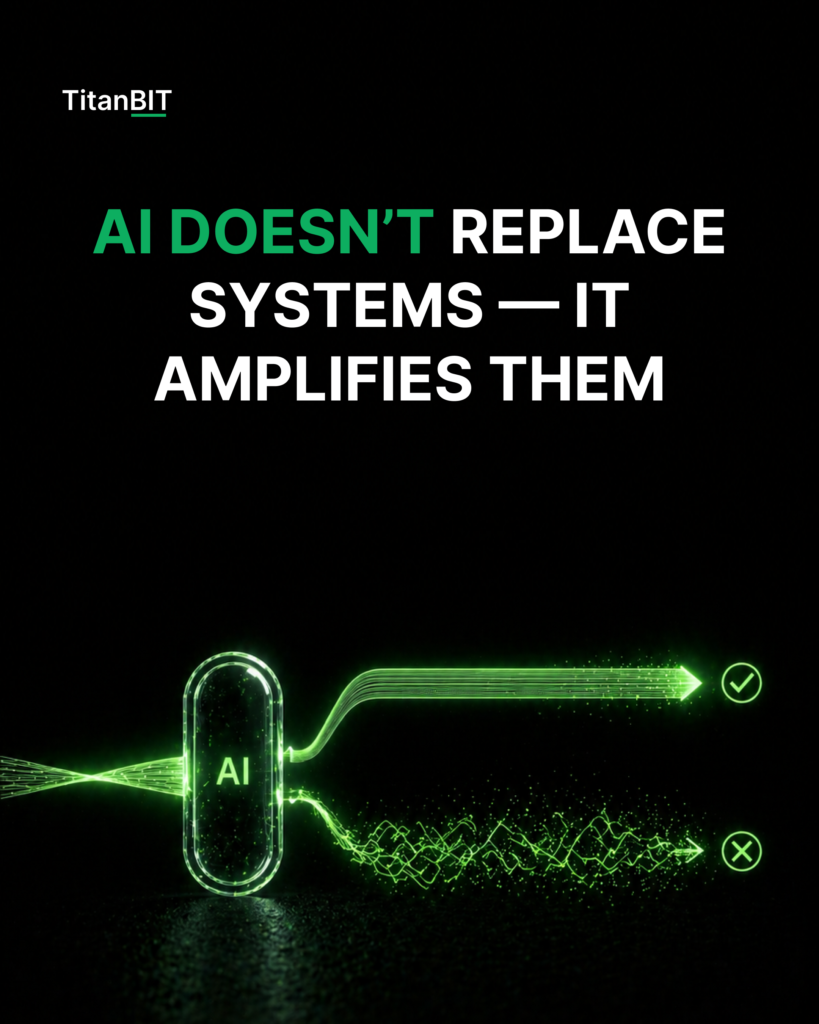
Artificial intelligence is often seen as a solution to inefficiency.
Many businesses expect AI to automate processes, improve performance, and reduce the need for manual work. On the surface, this expectation makes sense.
But in reality, AI does not solve structural problems.
How AI Actually Works in Business Systems
AI operates within the system it is given.
It processes data, follows workflows, and executes tasks based on existing structures. This means its effectiveness depends entirely on how the system is designed.
AI does not create clarity.
It does not fix broken processes.
It does not connect disconnected systems.
It amplifies what already exists.
The Risk of Introducing AI Too Early
When AI is introduced into a system without clear structure, it accelerates existing problems.
Unclear processes become faster but remain unclear.
Fragmented data becomes more complex.
Misalignment between teams scales across the system.
Instead of improving performance, AI increases complexity.
This is why many companies struggle after adopting AI tools. The issue is not the technology — it is the lack of a solid system behind it.
AI as a Multiplier of Structured Systems
High-performing companies take a different approach.
They design systems first.
They define processes, connect data, and ensure that every part of the system works together. Only then do they introduce AI.
In this context, AI becomes a powerful tool.
It increases speed, improves efficiency, and enhances decision-making — because it operates within a clear and structured environment.
Conclusion
AI is not a replacement for systems.
It is a multiplier.
If your system is not structured, AI will scale its weaknesses.
If your system is strong, AI will accelerate its strengths.
👉 The real question is:
Are you using AI to enhance your system — or to compensate for the lack of one?