
Data Is Growing — But Decision Quality Isn’t
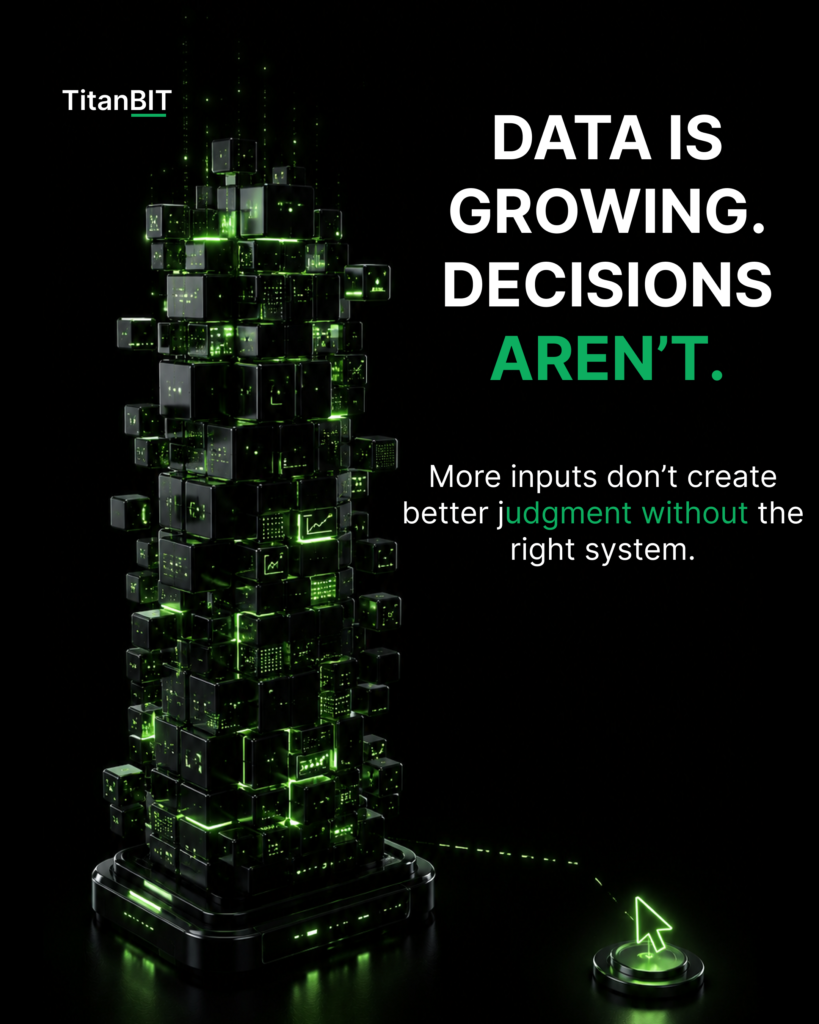
Modern companies have more data than ever before.
Every tool produces signals: CRMs, dashboards, analytics platforms, automation systems, AI tools, customer support channels, sales reports, and marketing campaigns. On the surface, this should help companies make better decisions.
But in many cases, decision quality is not improving. 📊
The reason is simple: more data does not create clarity by itself.
More Data Can Create More Noise
Data becomes valuable only when it is connected to context, ownership, and action.
If information is scattered across different platforms, teams see separate fragments instead of one clear picture. Marketing looks at campaign metrics, sales works with CRM data, operations tracks internal processes, and leadership receives reports after the fact.
Everyone has data, but not everyone sees the same reality.
This creates a decision gap. Teams may have access to more numbers, but still struggle to understand what matters, why something happened, and what should happen next.
Decision Quality Needs Structure
The real problem is not the amount of data. It is the lack of decision architecture.
A strong system defines where data comes from, how it is interpreted, who owns the decision, what actions should follow, and how results are measured.
Without this structure, even good data can become noise.
A dashboard may show that performance dropped, but not explain where the workflow broke. A report may show activity, but not reveal which action created impact. AI may summarize information, but if the process is unclear, the final decision can still be weak.
Better decisions require more than inputs. They require connected workflows, clear responsibility, and a system that turns signals into action.
How AI Can Help
AI can improve decision-making when it works inside a structured business system.
It can detect patterns, summarize large amounts of information, highlight risks, compare performance, and support faster analysis. But AI is not a replacement for decision structure.
If the data is fragmented, AI works with fragmented inputs. If ownership is unclear, insights do not move into execution. If workflows are disconnected, decisions stay slow even when analysis becomes faster.
That is why companies need to build AI-ready systems, not just add more AI tools.
From Data Volume to Decision Clarity
In 2026, competitive advantage will not come from collecting the most data.
Most companies already have enough information.
The real advantage will come from knowing how to use it: how to connect data, interpret signals, assign ownership, and turn insights into better decisions.
Because data growth without decision clarity does not create control.
It creates complexity.
And the companies that win will be the ones that turn data into decisions — not just dashboards.