
Every AI Decision Needs a Memory
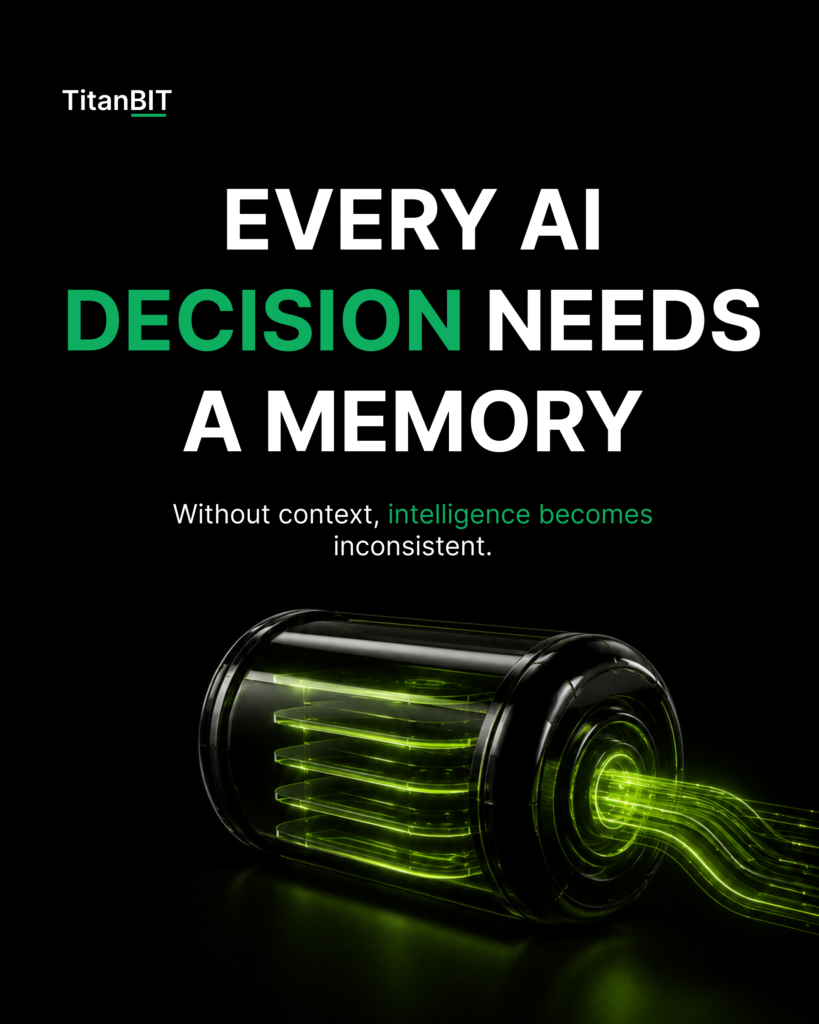
Artificial intelligence is often evaluated by the quality of its answers.
But in enterprise environments, consistency matters just as much as intelligence.
The difference between a useful AI system and a reliable one is rarely the model itself. More often, it is the system’s ability to remember context across workflows, decisions, and business processes. 🤖
Intelligence Without Context Creates Inconsistency
An AI model that treats every interaction as a new request will eventually produce conflicting outcomes.
It may ignore previous decisions, repeat completed work, overlook business rules, or respond differently to identical situations because it lacks historical awareness.
This isn’t a model problem.
It’s a memory problem.
Reliable business systems depend on continuity, not isolated responses.
Memory Creates Operational Intelligence
Enterprise AI becomes significantly more effective when it can reference previous interactions, workflow states, customer history, organizational policies, and decision logic.
Context allows AI to maintain consistency across departments, coordinate autonomous agents, and make decisions that align with broader business objectives.
Instead of generating isolated outputs, AI begins participating in an ongoing operational process.
That shift fundamentally changes its value.
The Next Layer of Enterprise AI
The future of AI is not defined only by larger language models or more advanced reasoning.
It is defined by persistent memory.
Organizations that successfully integrate contextual memory into their AI architecture will achieve greater consistency, higher operational reliability, and better long-term decision quality.
Because every intelligent decision depends on understanding what happened before.
In enterprise AI, memory is no longer an optional feature.
It is becoming the foundation of trustworthy execution. ⚙️