
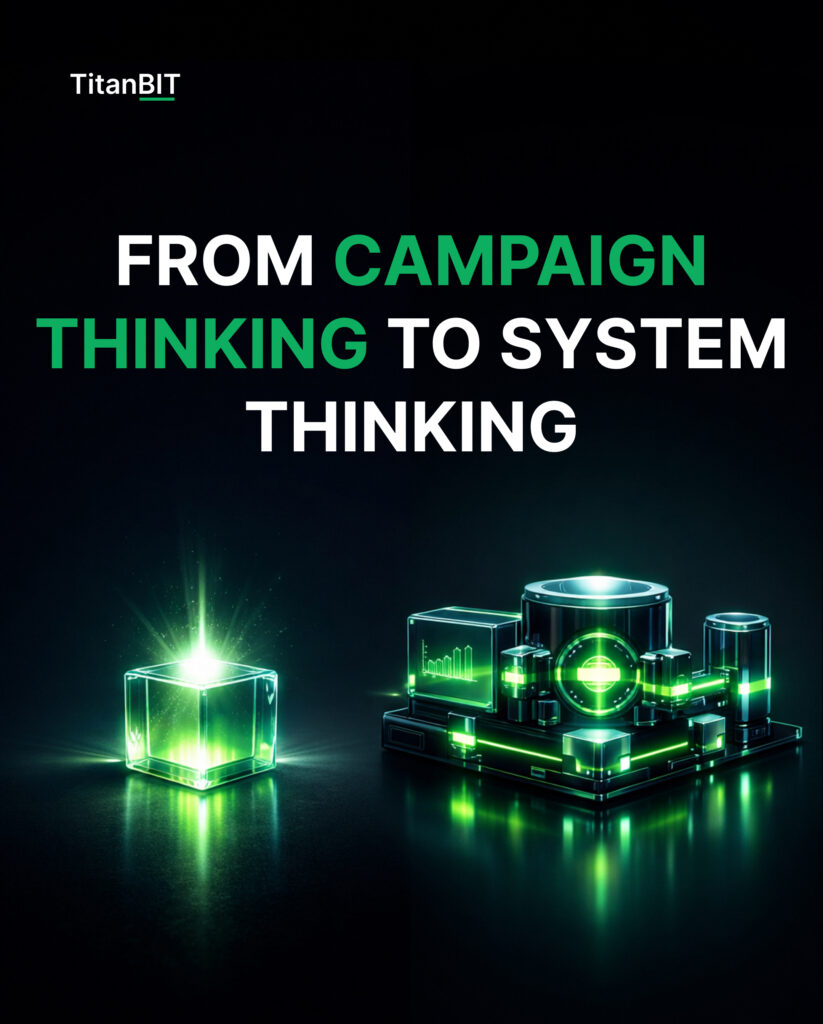
From Campaign Thinking to System Thinking
The Illusion of Growth
Marketing has long been driven by campaigns. Product launches, seasonal promotions, paid media pushes — each one designed to create visibility and drive results within a defined timeframe.
Campaigns work. But they don’t scale.
The illusion is that more campaigns equal more growth. In reality, more campaigns often mean more complexity, more coordination, and more manual optimization. 📈
Teams become busy. Dashboards multiply. Performance fluctuates. And each new quarter feels like a reset.
The underlying issue isn’t creativity or ambition. It’s structure.
Why Campaign Thinking Breaks at Scale
Campaign thinking is event-based. It treats marketing as a sequence of actions. Each action requires setup, monitoring, adjustment, and reporting.
This model creates several bottlenecks:
- Decisions are fragmented across tools and teams
- Data informs reports, not real-time action
- Optimization depends on human bandwidth
- Growth becomes dependent on continuous effort
As organizations expand, these bottlenecks compound. What worked for a small team becomes unstable at scale.
Adding more budget doesn’t solve it. Adding more people doesn’t solve it.
Because the issue isn’t resources. It’s architecture.
What System Thinking Changes
System thinking reframes marketing as infrastructure.
Instead of asking, “What campaign are we launching next?”, the question becomes:
How does our marketing engine function as a whole?
In a system-based model:
- Channels are orchestrated, not siloed
- Data flows automatically into decision layers
- Optimization is embedded, not reactive
- Performance becomes repeatable
Automation and intelligent decision frameworks play a central role here. Not as isolated tools, but as structural elements that reduce dependency on manual control.
The shift is subtle but powerful.
Marketing stops being a series of events and becomes a coordinated operating system.
From Motion to Momentum
Campaigns create motion.
Systems create momentum.
Motion requires constant energy. Momentum builds on itself.
Organizations that move from campaign thinking to system thinking gain something far more valuable than short-term spikes: predictability. And predictability is what makes true scaling possible.
The question is no longer about running better campaigns.
It is about building better systems.
If your growth depends on constant manual effort, it may be time to rethink the foundation.