
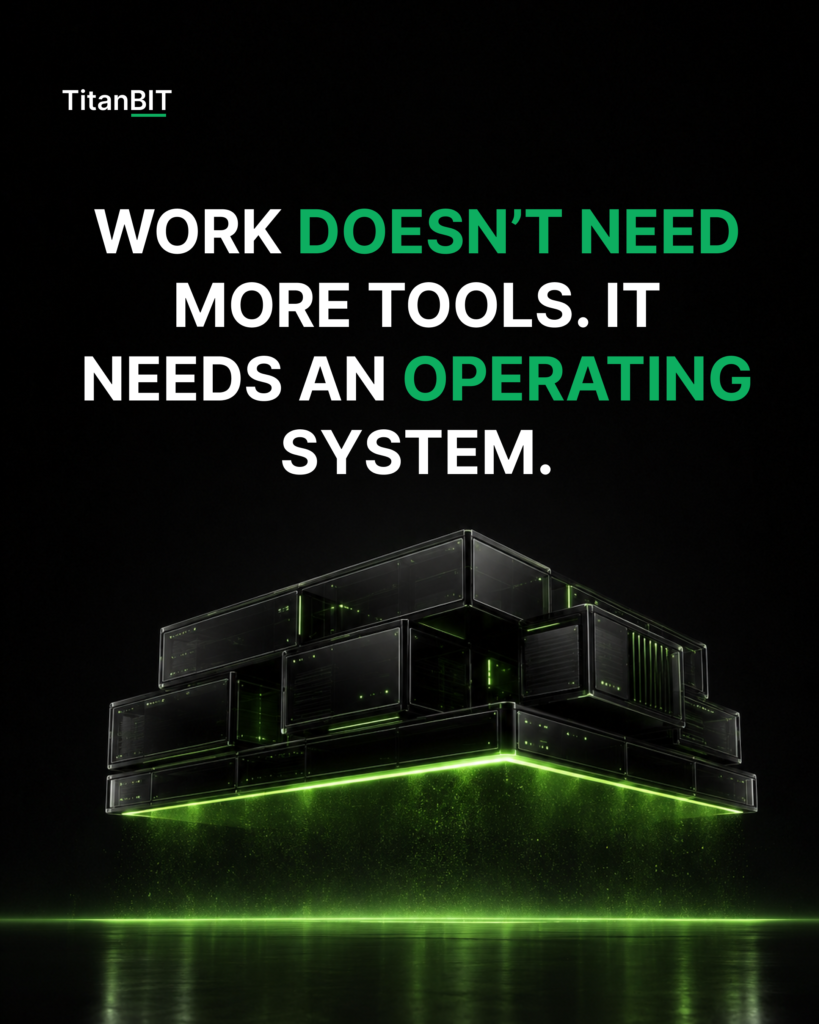
Work Doesn’t Need More Tools. It Needs an Operating System.
Businesses have never had access to more technology than they do today.
CRMs, analytics platforms, AI assistants, automation software, project management tools, customer support systems—every year the software stack continues to grow. Yet many companies still struggle with slow execution, fragmented workflows, and disconnected teams.
The problem is rarely the lack of tools.
More often, it is the lack of an operating system that connects them. ⚙️
More Software Doesn’t Mean Better Execution
Every tool is designed to solve a specific problem. CRM platforms organize customer relationships. Analytics tools measure performance. AI accelerates repetitive work and supports decision-making. Automation removes manual tasks.
Individually, these solutions are valuable.
But without a shared operating logic, they become isolated islands of information. Teams spend time transferring data between systems, manually coordinating work, and filling operational gaps instead of creating value.
As the software stack grows, complexity often grows with it.
Why Companies Need an Operating System
An operating system is not another application.
It is the architecture that connects workflows, ownership, information, automation, and decision-making into one coordinated environment.
Instead of asking people to connect disconnected tools, the system defines how work flows across the organization. It establishes clear ownership, consistent processes, and visible execution from start to finish.
This creates something individual tools never can: operational consistency.
AI Works Best Inside a System
AI becomes far more valuable when it operates inside a connected business architecture.
Instead of acting as another standalone tool, it becomes part of the operating model—supporting decisions, triggering workflows, coordinating actions, and reducing manual work without creating additional fragmentation.
Technology should reduce complexity, not increase it. 🧠
Building Systems Instead of Stacks
The companies that gain a competitive advantage over the next few years will not necessarily own the most software.
They will build the strongest operational architecture.
Because businesses don’t scale by collecting more tools.
They scale by designing systems that allow every tool, every workflow, every decision, and every team to operate as one.