
Autonomy Without Boundaries Becomes Risk
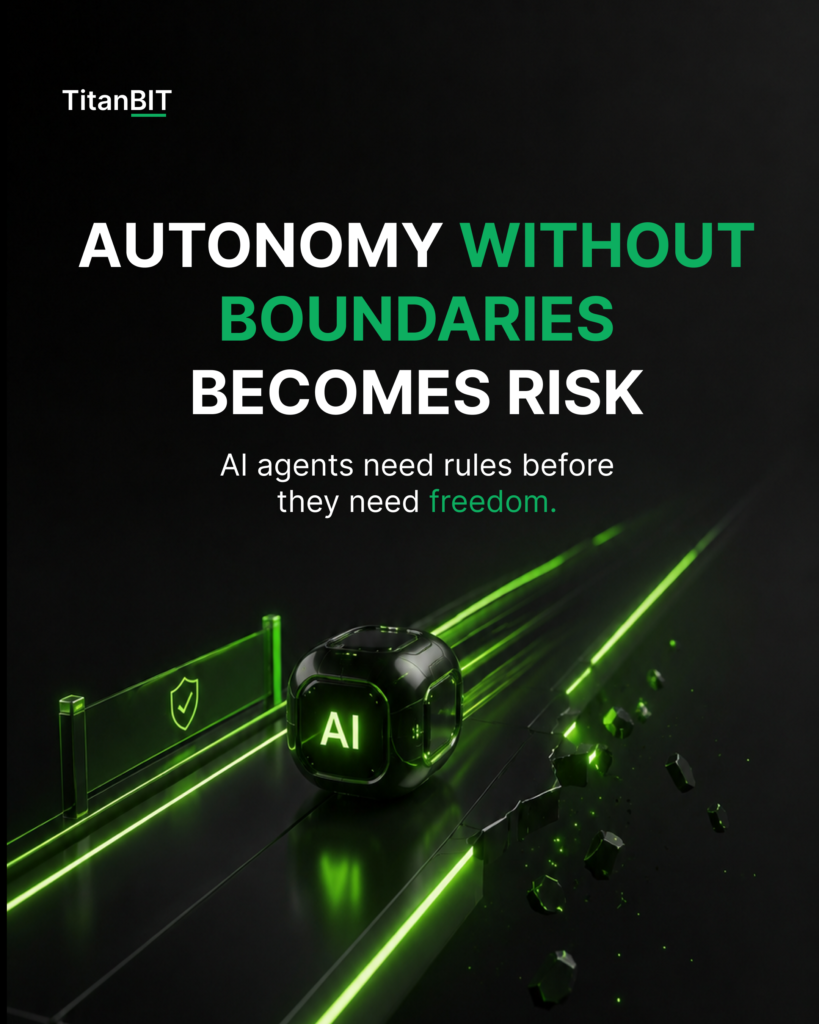
AI agents are becoming a new layer of business automation. They no longer only answer questions or generate content. Modern AI agents can analyze data, use tools, plan multi-step tasks, trigger actions, connect workflows, and support decisions inside business systems.
For companies, this creates a clear opportunity: faster execution, less manual coordination, and more scalable operations. But the same autonomy that creates value can also create risk. ⚙️
Why AI Agent Autonomy Needs Boundaries
Autonomy sounds attractive because it promises speed. If an AI agent can complete tasks without constant human input, teams can move faster and reduce repetitive work.
But when an agent can access data, update systems, send messages, or trigger workflow actions, it becomes part of the company’s operating model. It is no longer just a tool. It is an active participant in execution.
That is why companies need to define boundaries before scaling agentic AI.
An AI agent should have clear rules: what data it can access, which actions it can perform, when approval is required, who monitors its behavior, and who owns the final outcome.
Without these answers, autonomy becomes difficult to control.
Governance Makes AI Scalable
AI governance is often seen as something that slows innovation down. In reality, it is what makes AI agent systems scalable.
Clear permissions, access control, approval logic, monitoring, and ownership help companies use AI safely. They prevent agents from acting outside their role, accessing unnecessary information, or making decisions without accountability.
This does not mean every action must stay manual. It means the company should clearly define which actions can be automated, which require human approval, and which should never be handled by an agent.
Good governance does not reduce AI value. It protects it. 🔍
Controlled Autonomy Is the Real Advantage
Agentic AI creates value when it works inside a structured business system. A strong system defines access, rules, workflows, responsibility, and visibility.
This allows AI agents to move fast, but not blindly. They can reduce manual work, support decisions, and improve execution while staying inside clear operational boundaries.
Without this structure, AI agents can automate confusion, scale mistakes, and make responsibility harder to trace. With the right governance, they can become a safe and powerful layer of workflow automation.
The Future of Agentic AI
The future of AI in business is not unlimited autonomy. It is controlled autonomy.
Companies will not win by giving agents more freedom without structure. They will win by building AI-ready systems where every agent has clear permissions, visible behavior, defined ownership, and measurable impact.
Because AI agents need rules before they need freedom.
Autonomy without boundaries is not innovation.
It is operational risk.