
Most Companies Don’t Have Funnels — They Have Disconnected Journeys
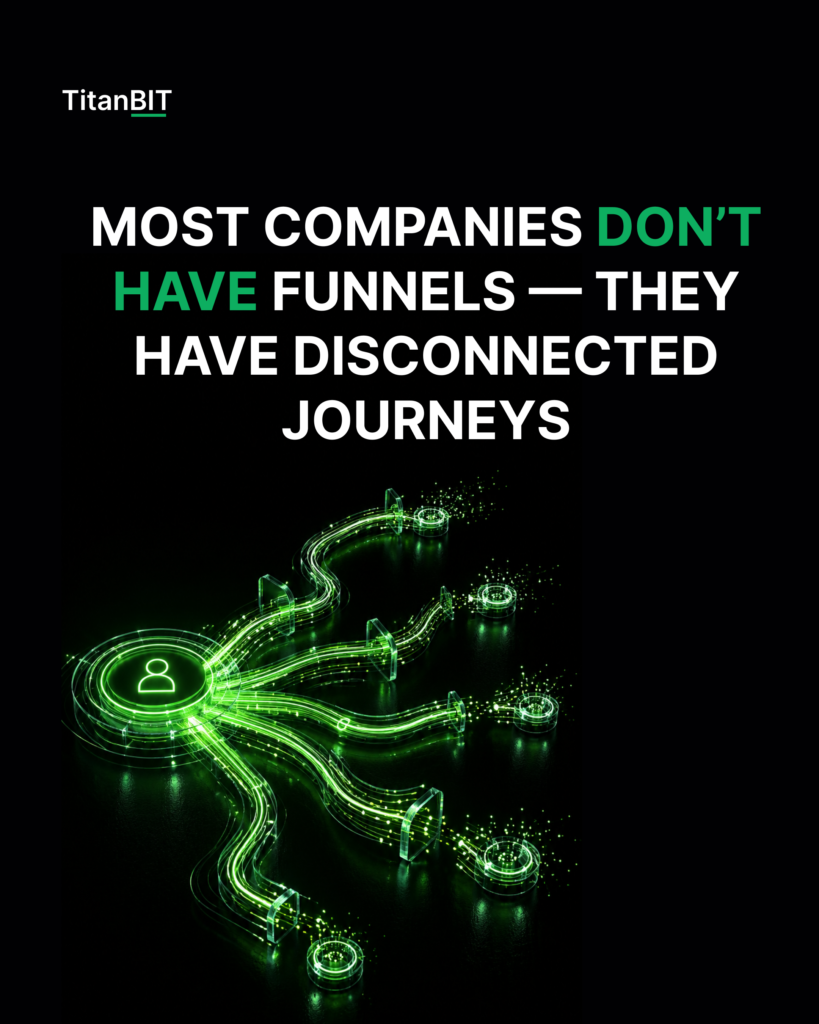
Funnels are one of the most commonly used concepts in marketing. Businesses design funnel stages, map user flows, and assume that customers move step by step toward conversion.
However, in practice, this rarely reflects reality.
Most companies do not operate true funnels.
They operate disconnected journeys.
The Illusion of a Funnel
On the surface, everything appears structured. There are defined stages, metrics for each step, and tools that track user behavior.
But when you look deeper, the system is fragmented.
Users enter from multiple channels, interact with different platforms, and experience inconsistent messaging. Instead of following a clear path, they move unpredictably between touchpoints.
This breaks the logic of a funnel.
Where Journeys Become Disconnected
The problem is not in individual steps. Many of them work well in isolation.
The issue is in the lack of connection between them.
Marketing, sales, and product interactions are often not aligned. Data does not flow consistently. Handoffs between stages are unclear.
As a result, users drop off or fail to progress.
This creates gaps where value is lost.
Why Funnels Require Systems
A funnel is not just a sequence of stages.
It is a system that ensures continuity.
Each step must lead naturally to the next. Each interaction must support progression. Without this, the funnel does not function as a cohesive structure.
Disconnected journeys create friction and inconsistency. Even with strong traffic, the system fails to convert effectively.
Conclusion
Most companies do not have a funnel.
They have multiple journeys that never converge.
The key to growth is not adding more entry points or optimizing individual steps. It is building a system where all parts are connected and aligned.
Because without connection, there is no progression.